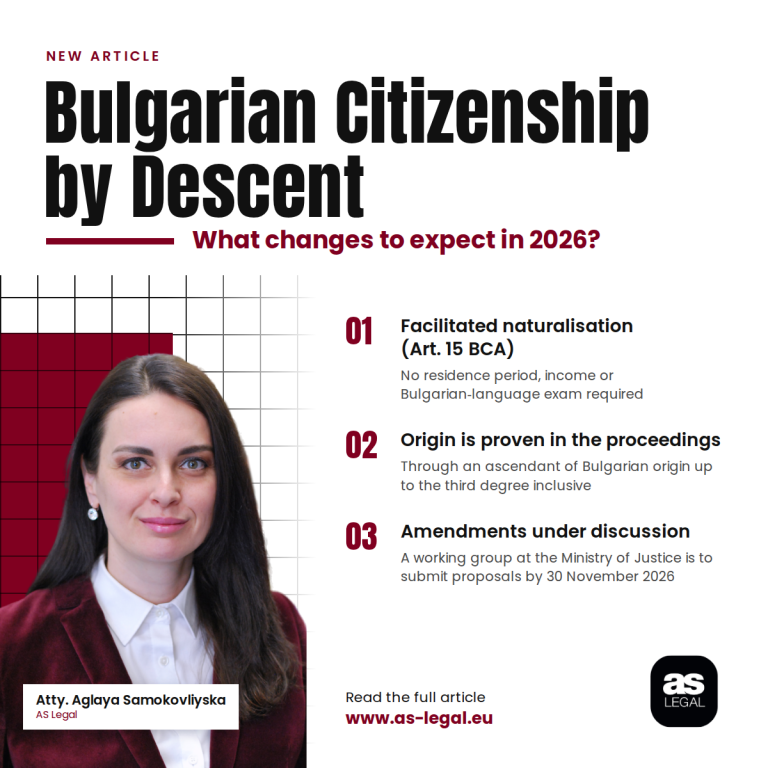
More people with Bulgarian roots around the world want to restore their connection to Bulgaria and with it, the citizenship of a European Union member state. Acquiring Bulgarian citizenship by descent is a privileged route, but after the recent legislative changes the procedure requires precise documentary preparation.
Who can acquire citizenship under Article 15 BCA
Under Article 15(1) of the Bulgarian Citizenship Act (BCA), a person who is not a Bulgarian citizen may acquire citizenship by naturalization without meeting a number of the general requirements (including the residence period, income and the Bulgarian-language exam), provided they fall into one of the following three categories:
- a person of Bulgarian origin;
- a person adopted by a Bulgarian citizen under full adoption;
- a person one of whose parents is a Bulgarian citizen or died as a Bulgarian citizen.
Bulgarian origin is established within the proceeding itself
The Bulgarian Citizenship Act requires that, together with the application, the applicant submit official documents issued by Bulgarian or foreign authorities establishing that they have a family relationship with at least one person – an ascendant up to the third degree inclusive – who is of Bulgarian origin. The documents must contain the ascendant's names and their kinship link to the applicant.
Within the proceeding, the Advisory Council at the State Agency for Bulgarians Abroad (SABA) may issue a reasoned positive or negative opinion on the Bulgarian origin (Article 29(6) BCA). The Council assesses whether the applicant speaks Bulgarian, whether they self-identify as a person of Bulgarian origin, and whether at least one of the following circumstances applies:
- the applicant is part of a Bulgarian community or minority in another state;
- they originate from a place that was historically part of the Bulgarian state or of the Bulgarian Exarchate;
- they have ascendants bearing the traditional Bulgarian family-name system.
This framework, further developed by the amendments in force from 31 January 2026, makes proof of origin a matter of a well-prepared file rather than a formality.
In practice, the Ministry of Justice interprets the notion of “Bulgarian” in terms of a person’s ethnic belonging, not their legal connection to the state. When assessing documents, the specific circumstances of individual countries and regions are also taken into account – for example, regarding the Bulgarian communities in Albania and Ukraine, where, due to the historical situation, it is not always possible to produce older documents.
Required documents
Beyond the kinship documents, the Article 15 of BCA procedure also requires:
- the standard application form, written in Bulgarian;
- a transcript or duplicate of the birth certificate;
- a criminal-record certificate from the country of citizenship (and from Bulgaria or a third country in case of long-term residence there);
- a prosecutor's certificate in case of long-term residence in Bulgaria;
- a medical certificate from a medical advisory board;
- a declaration in the standard form (Annex No. 4);
- documents on any change of names and on the identity of a person bearing different names;
- an autobiography, a recent photograph and a copy of an identity document;
- proof of the paid state fee.
Foreign documents must meet the legalization requirements (apostille or consular certification) and be accompanied by an official Bulgarian translation prepared in accordance with the applicable rules.
The Ministry of Justice is strengthening control over the authenticity of the documents submitted. Where there is doubt, they are sent for forensic examination, and where a document is found to be false, the file is referred to the prosecutor's office. These checks can take eight to nine, and in some cases up to twelve months.
Procedure and timelines
The application is filed in person at the Ministry of Justice in Sofia or at a Bulgarian diplomatic/consular mission abroad. The applicant undergoes an interview in Bulgarian; where they do not speak the language, an interpreter is arranged. The statutory decision period for applications by persons of Bulgarian origin is nine months, but in practice preparation and the curing of deficiencies can extend the process considerably.
Where the documentary link is incomplete or contested, Bulgarian origin can be established through court proceedings.
An interinstitutional working group has been set up at the Ministry of Justice which, by 30 November 2026, must prepare proposals for amendments to the Bulgarian Citizenship Act, its secondary legislation and the rules for its application. Among the measures under discussion is a return to the longer, pre-2021 deadlines (with some extension), since the mandatory coordination with other institutions (the Ministry of the Interior and the State Agency for National Security) and the verification of document authenticity do not, in practice, fit within the shortened deadlines. The aim is to unify and modernize the legal framework and to overcome the accumulated backlog of cases.
How we can help
AS Legal advises and represents clients throughout the procedure for acquiring Bulgarian citizenship by descent: analyzing the kinship link, collecting and legalizing documents, preparing the application and the declarations, accompanying the applicant, liaising with the Ministry of Justice, and defending against refusals, including before the courts.
Contact us for an individual assessment of your case
Tell us about your family history and documents – we will advise you on the right next step.
Contact usThis publication is for information purposes only and does not constitute individual legal advice. For a specific matter, please seek professional legal counsel.